Roof lead-through for tiled roofs: The professional guide for electricians & solar installers
The roof lead-through is one of the most critical points of any PV installation on a tiled roof – and yet one of the most frequently underestimated. Those who cut corners here or rely on unsuitable solutions risk cable damage, complaints, and, in the worst-case scenario, liability problems. This guide is aimed at specialist companies: electricians, solar installers, and roofers who work with photovoltaic systems daily and want to know what really matters in professional cable routing through the tiled roof.
Why the roof lead-through determines the long-term success of the PV system
In a PV installation on a pitched roof, the path from the module to the house connection inevitably leads through the roof surface. At this point, two worlds meet: the weather-exposed exterior and the protected interior. If this transition is not carefully executed, problems will arise that often only become apparent after months or years.
Typical consequences of poor roof lead-throughs:
- Cable abrasion and insulation damage due to sharp tile edges without protective devices
- Moisture ingress if cable routes are not correctly integrated into the roof tile geometry
- Cable pull and tension if the cable is fixed without strain relief
- MC4 dismantling on the roof – time-consuming and risky with DC voltage
In short: A professional roof lead-through protects the cable, secures the installer against liability, and saves time and money in the long run. Those who plan correctly from the start will not have to retrofit later.
The 3 most common mistakes in PV roof lead-through on tiled roofs
Mistake 1: Cable routed directly over tile edge – without protection
Many installations simply route the cable over or under the edge of the tile. While this may look aesthetically acceptable, it is mechanically problematic: tile edges are sharp and rough. Under wind loads, thermal expansion, and settlement movements of the building, the cable inevitably rubs against the edge – and the insulation gives way. The result: insulation damage after a few years, which only becomes apparent during the next monitoring.
Solution: A specialized cable lead-through that guides the cable cleanly through the tile and provides reliable abrasion protection.
Mistake 2: Dismantling MC4 connectors on the roof
Many older lead-through systems require the MC4 connector to be unplugged and then re-plugged after routing. This not only takes time – it also entails risks. Every dismantling is a potential weak point for later contact problems. Anyone who installs many systems knows the problem: A faulty MC4 contact is difficult to find and expensive to repair.
Solution: Systems where the MC4 connector remains assembled and the cable, including the connector, is guided through the roof lead-through.
Mistake 3: Incorrect product choice for the tiled roof
Not every roof lead-through fits every roof. Anyone who buys a system designed for corrugated sheet metal, flat roofs, or wave panels and then uses it on a tiled roof will struggle with fit problems. The result: improvised solutions, leaks, and additional effort on the construction site.
Solution: Only use products that are explicitly designed and tested for pitched roofs and tiled roofs.
What specialist companies should look for when choosing products
UV resistance: The product is permanently exposed to sunlight. Materials that are not UV-stabilized become brittle within a few years. Pay attention to the explicit statement in the data sheet: "UV-resistant technical plastic" – not just "plastic."
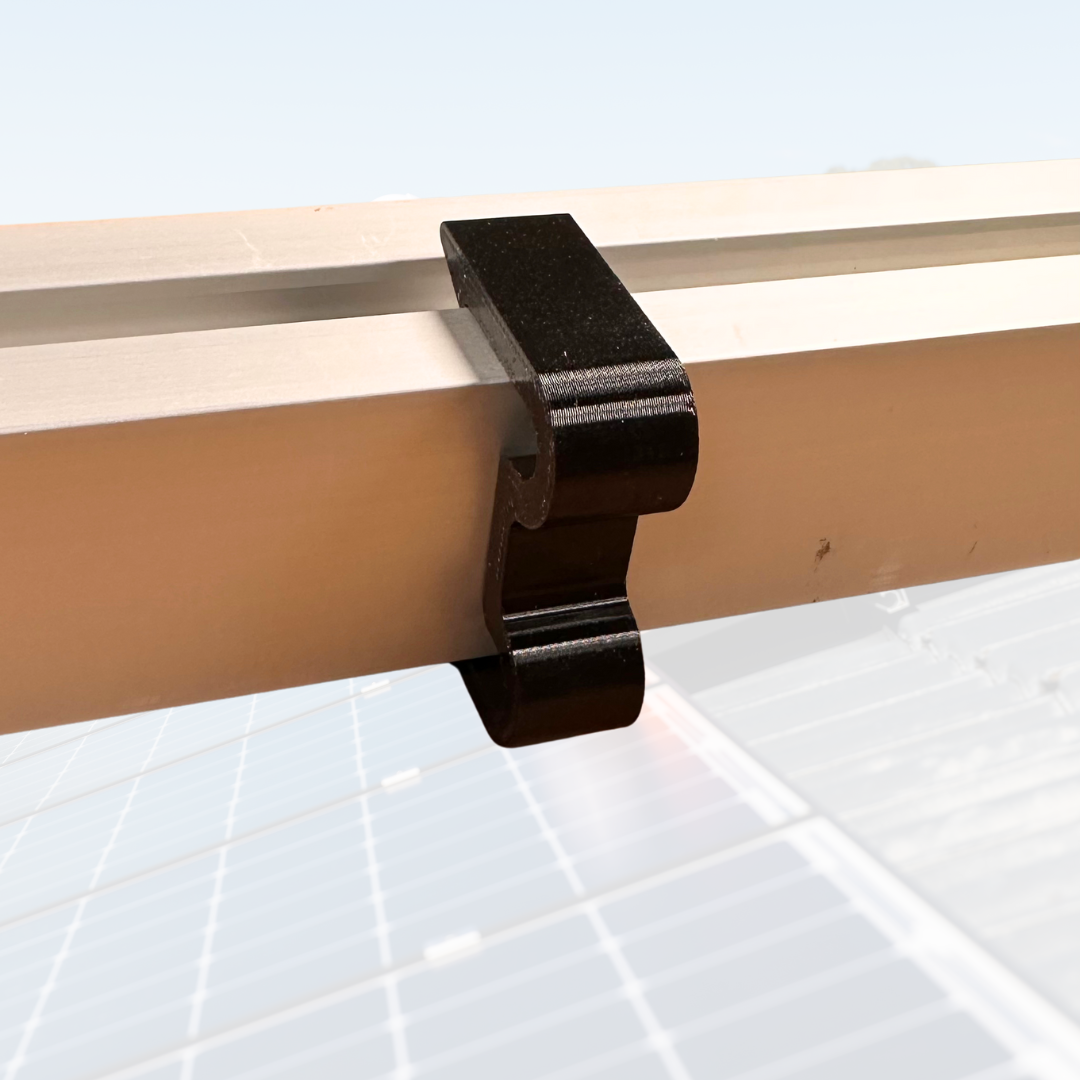
Fit for tile geometry: The roof lead-through must be able to hook cleanly into the overlap of the tile. Only then is it ensured that no additional sealing or adjustment is necessary.
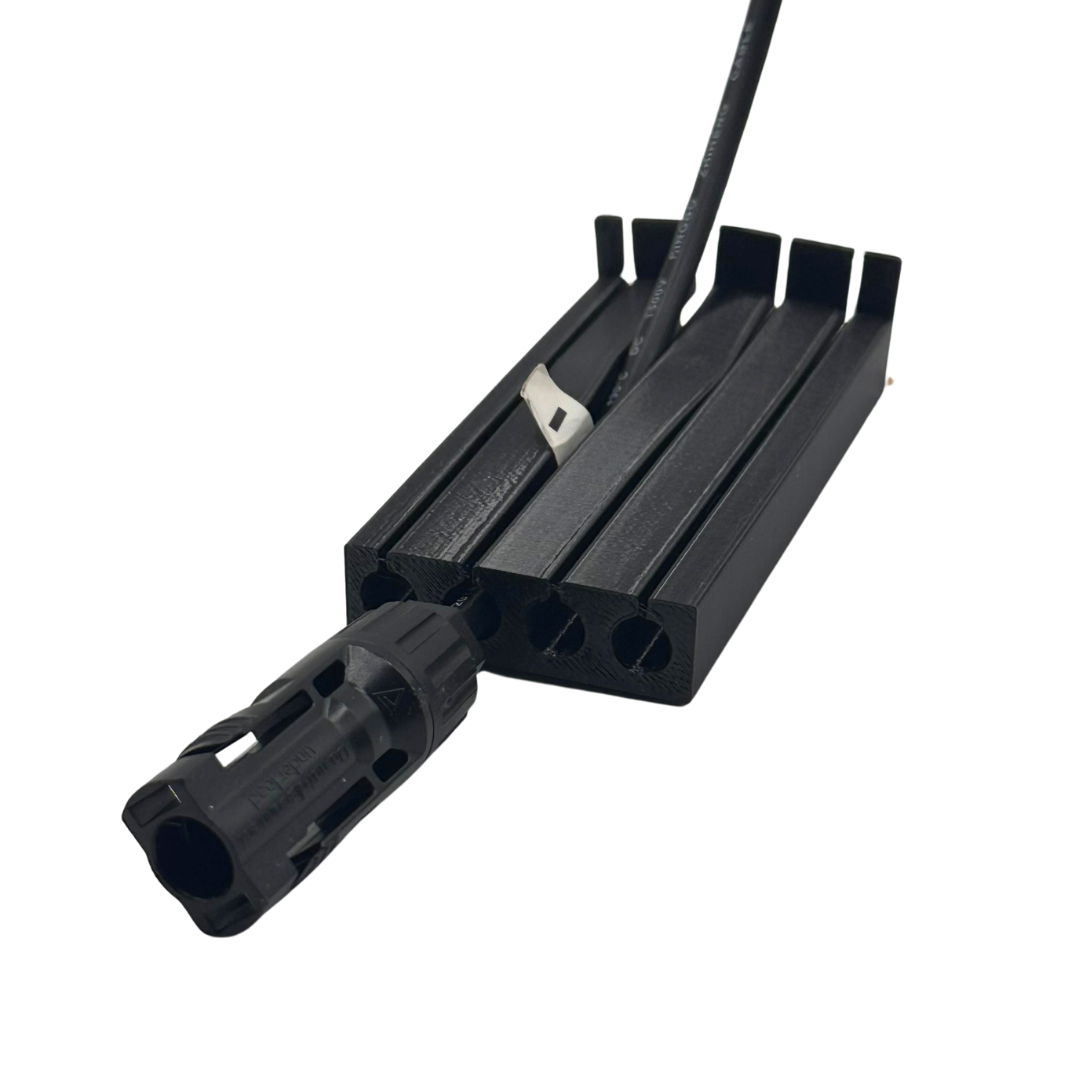
Cable configuration: Depending on the system size and module wiring, you need different duct variants. For small systems, 2 PV cable ducts are sufficient; larger systems require 4 or 6 ducts – each with or without an earthing duct (PE).
Cable diameter compatibility: Standard PV cables have an outer diameter of approx. 7.5 mm. Earthing cables can have a diameter of up to 16 mm. Both must fit without widening.
Installation speed: Every minute counts on the construction site. Systems that can be installed without special tools and where the MC4 connector does not have to be dismantled save several minutes per installation – with 50 lead-throughs per month, this adds up to hours.
Availability in package sizes: Specialist companies that regularly install need packages in practical sizes: units of 20, 50, 100, 500, or 1,000.
Step-by-step: Installation of the NEXCAPE® PV cable roof lead-through in under 10 minutes
The NEXCAPE® PV cable roof lead-through is designed for pitched roofs with tile covering. It is available in three lengths – 105 mm, 125 mm, and 150 mm – and thus covers the common tile thicknesses and overlap depths.
Quick guide:
- Prepare cable routing: Route the PV cable to the planned lead-through point. The MC4 connector remains assembled – no dismantling required.
- Select lead-through position: Choose a spot in the tile row where the overlap provides sufficient space for the lead-through. The length of the roof lead-through (105 / 125 / 150 mm) depends on the tile geometry.
- Insert and hook in: The NEXCAPE® roof lead-through is hooked into the roof tile – no drilling, no gluing, no special tools.
- Thread cable: The cable is guided through the designated channel. Abrasion protection is already integrated into the design of the lead-through.
- Check fixation: Quick fit check – the lead-through must sit firmly in the tile row.
Result: Clean, professional cable routing with integrated abrasion protection – maintenance-free and durable. Made in Germany.
Product overview: Which variant for which order?
The NEXCAPE® PV cable roof lead-through is available in three lengths and six cable configurations:
By length (depends on tile geometry):
- 105 mm – for shallower tile profiles and lower overlap depths
- 125 mm – standard variant, fits most tiled roofs in Germany
- 150 mm – for deep tile profiles and larger overlap areas
By cable configuration: 2PV | 2PV+PE | 4PV | 4PV+PE | 6PV | 6PV+PE
| Property | Value |
|---|---|
| PV cable Ø | approx. 7.5 mm |
| Earth cable Ø | up to 16 mm |
| Material | UV-resistant technical plastic |
| Application area | Pitched roofs / Tiled roofs |
| Manufacturing | Germany |
Package prices for specialist companies: Stock up now for the spring season
Specialist companies that regularly install PV systems on tiled roofs should stock up now for the high season. The NEXCAPE® PV cable roof lead-through is available in the following package sizes: 20 | 50 | 100 | 500 | 1,000 pieces
Especially in the current season, it is worthwhile to build up stock: The PV market is running stably with around 400,000 new installations per year in Germany.
Contact for package offers and advice:
Email: support@nexcape.de
Phone: 07054 927999
FAQ: Frequently asked questions about roof lead-through on tiled roofs
Which cable lead-through fits my tiled roof?
The suitable length (105 / 125 / 150 mm) depends on the depth of the tile profile. We recommend 125 mm as the standard variant. If you are unsure, our team at 07054 927999 will be happy to help.
Do I have to dismantle the MC4 connector for installation?
No. The MC4 connector remains assembled. This saves time and prevents potential contact problems.
Is the roof lead-through also suitable for flat roofs or corrugated sheet metal?
No. The NEXCAPE® PV cable roof lead-through is designed exclusively for pitched roofs with tile covering.
Which cable cross-sections fit?
Standard PV cables with an outer diameter of approx. 7.5 mm fit easily. Earthing cables up to 16 mm outer diameter can be routed through the PE channel.
In what quantities are the roof lead-throughs available for order?
In packages of 20, 50, 100, 500, and 1,000 pieces – no individual sales.
Conclusion
Every PV system you install on a tiled roof deserves a roof lead-through designed for exactly this application. With the NEXCAPE® PV cable roof lead-through, specialist companies receive a system that is quick to install, requires no tools, protects the MC4 connector, and reliably performs its service for years thanks to UV-resistant technical plastic.
Further information: Cable management in PV systems | Avoid typical installation errors
Request a package offer now: support@nexcape.de | 07054 927999