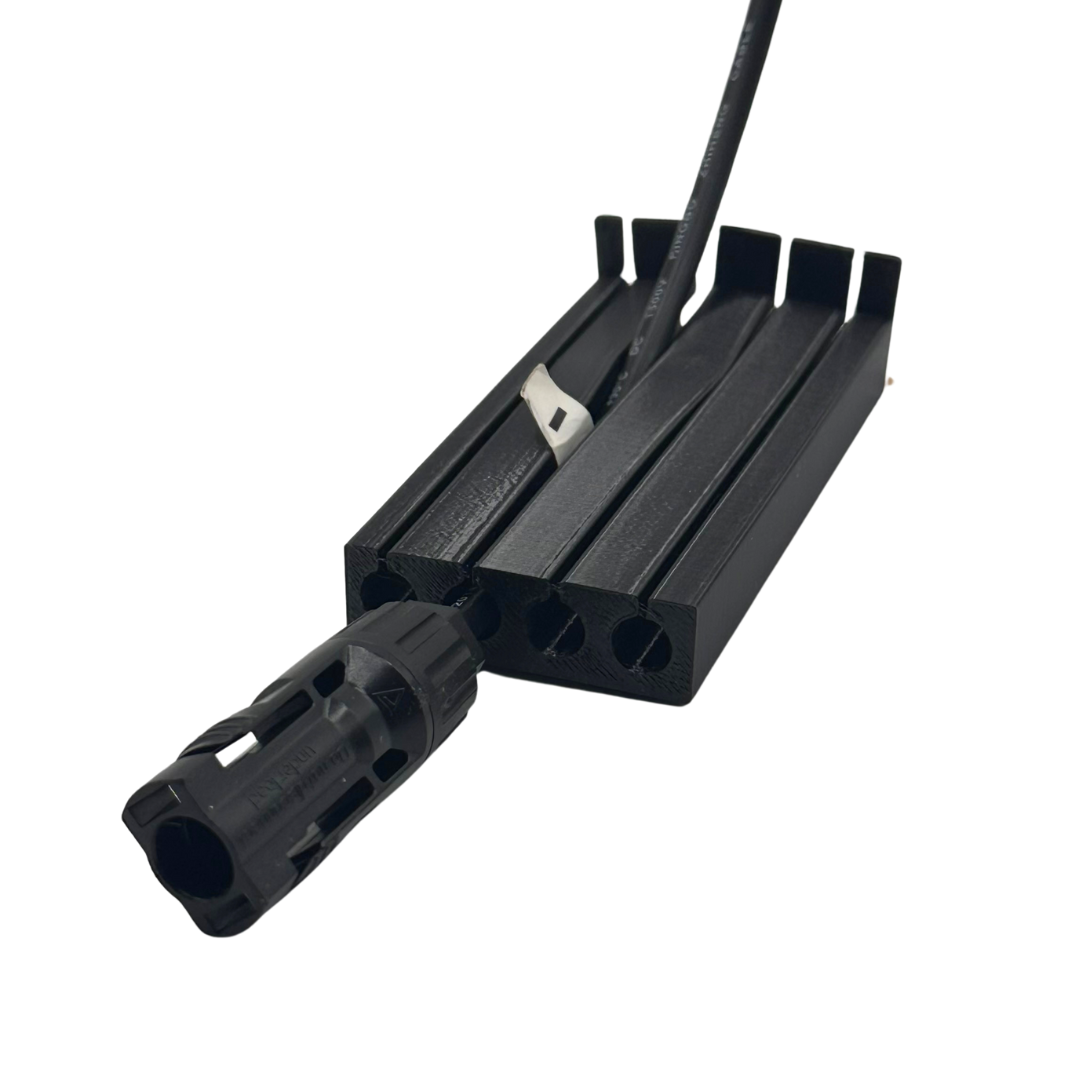
Brief for Practical Use: The D24 roof duct is available with 3 or 5 entries. The number of entries determines how many conductors you can cleanly route through the roof at one point – including equipotential bonding. The choice depends on the number of strings in the system, while the length (105/125/150 mm) depends on the tile overlap. For context: the component is an abrasion protection that prevents the cable from chafing at the edge of the tile – it is not a sealing component; rain protection comes from the roof covering itself.
3 or 5 Entries – The Quick Decision
- 3 entries = 2 PV conductors + equipotential bonding. The standard for a single string: positive, negative, and the protective conductor. Covers the majority of rooftop installations with one module string.
- 5 entries = 4 PV conductors + equipotential bonding. For two strings at the same penetration point – or as a deliberate reserve if the customer wishes to expand later.
Rule of thumb for calculation: One string → 3 entries. Two strings or planned expansion → 5 entries. Equipotential bonding is already included in both – no second penetration needed.
Length: 105, 125, or 150 mm
The millimeter specification refers to the length of the penetration, not the tile width. The crucial factor is how much the roof tiles overlap – this varies from roof to roof, depending on the installation method. More overlap requires a longer penetration (towards 150 mm), while less overlap means 105 mm is sufficient. When in doubt, choose the longer variant: too short leaves a section of the cable resting on the tile edge, too long does no harm.
Why Abrasion Protection Matters to You as a Specialist Company
The damage doesn't show up during acceptance, but years later: wind, temperature changes, and micro-movements cause the cable to chafe through at the sharp tile edge – leading to wire breakage, short circuits, and in the worst case, an arc fault. For you, this means complaints and costly follow-up work on the roof. A dedicated penetration made of TPU (flexible, UV and weather resistant, Made in Germany) keeps the cable permanently away from the edge. Practical on the construction site: The cable can be inserted without removing the connectors – saving time per penetration.
Frequent Questions from Daily Business
When are 3 entries sufficient?
For a single string – meaning 2 PV conductors plus equipotential bonding. This is the most common case.
Is equipotential bonding always included?
Yes, in both the 3-entry and 5-entry variants, there is an opening provided for the protective conductor.
Does the penetration make the roof watertight?
No – it is an abrasion protection for the cable, not a sealing component. Rain protection is provided by the correctly installed tile covering above it.
Conclusion
The decision is made in two minutes: Entries based on the number of strings (3 for one string, 5 for two strings/reserve), length based on tile overlap (if in doubt, go longer). Which variant suits which tile model can be found in the guide Which PV roof duct do I need?
All variants at a glance in our category PV Cable Glands – Abrasion Protection for Solar Cables.